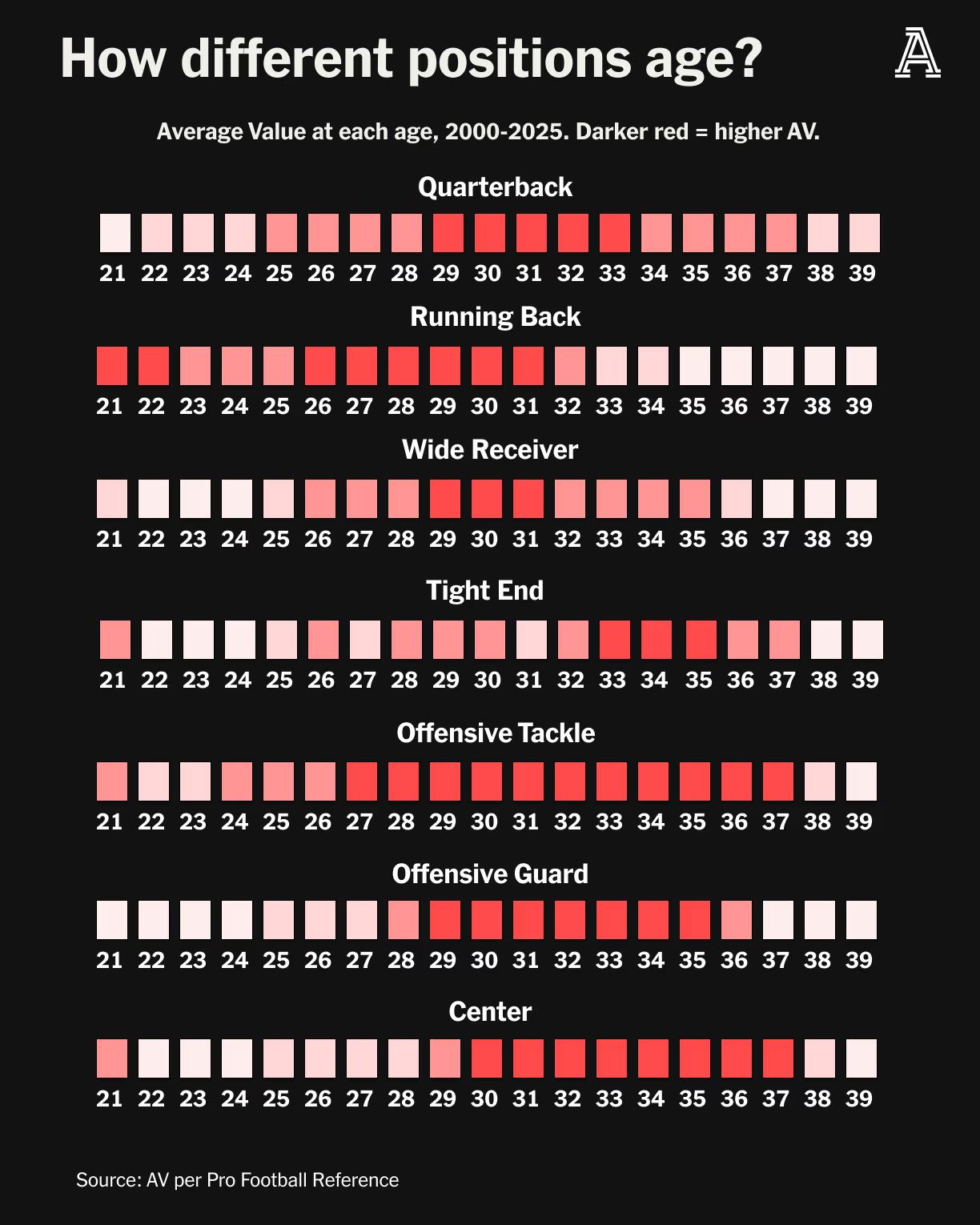
The Athletic just published a study on NFL peak performance ages (subscribe — it’s been worth it for six-plus years running), and it should change how you draft. The old NYT stat said the average NFL career lasts 3.5 years. Misleading. Once a player actually makes a team’s roster, the real number is approximately 6 years. A first-round pick, and it’s 9. Survivorship bias was hiding the real story: elite players stick around, and they keep producing — often well past the age fantasy managers assume they’re done.
Key Takeaways
- QBs peak at 29–33 — Herbert and other young arms may not have hit their ceiling yet
- Elite RBs have a second peak window from 26–31 — don't fade Henry or CMC
- Pro Bowl WRs peak between 28–31 — don't forget great players like Davante Adams
- TEs peak between 33–35 — Kittle decline talk is premature
What the Data Shows
- QB peak: 28–33, best average production at 29–33. A 26- or 27-year-old like Justin Herbert may still be a year or two from his biggest fantasy season.
- TE peak stretches into the mid-30s — best average production at 33–35. This is the most surprising finding in the piece.
- RB best-season windows: 21–22, then again 26–31. Less of a shift than other positions, but the tail is longer than assumed for the truly elite.
- WR best average production: 29–31.
- League-winning, career-year performances can happen at any age — but for QBs and TEs, they skew more likely at or after 30, not less.
Why the Old Framing Was Wrong
“Career length” and “peak production” are two different stats, and fantasy analysis has been treating them as one. A 3.5-year average career says nothing about when a rostered, productive player is at his best. Once you filter for players who actually stuck — especially first-round picks — the aging curve looks completely different than the conventional “running backs die at 30” wisdom fantasy managers have repeated for two decades.
Applying This to Your Roster
Quarterbacks: If QB primes run 28–33, a young franchise arm like Herbert isn’t just “already good” — he may not have hit his ceiling yet. Don’t assume a 26-year-old QB’s current numbers are his best-case scenario.
All-Time Elite QB Seasons (Half-PPR, 1 per QB)
| Rank | Season | Player | Team | Age |
|---|---|---|---|---|
| 1 | 2024 | Lamar Jackson | BAL | 27 |
| 2 | 2013 | Peyton Manning | DEN | 37 |
| 3 | 2018 | Patrick Mahomes | KC | 23 |
| 4 | 2011 | Aaron Rodgers | GB | 27 |
| 5 | 2021 | Josh Allen | BUF | 25 |
| 6 | 2011 | Drew Brees | NO | 32 |
| 7 | 2015 | Cam Newton | CAR | 26 |
| 8 | 2016 | Matt Ryan | ATL | 31 |
| 9 | 2007 | Tom Brady | NE | 30 |
| 10 | 2004 | Daunte Culpepper | MIN | 27 |
| 11 | 2020 | Kyler Murray | ARI | 23 |
| 12 | 2022 | Jalen Hurts | PHI | 24 |
| 13 | 2021 | Justin Herbert | LAC | 23 |
| 14 | 1999 | Kurt Warner | STL | 28 |
| 15 | 2010 | Michael Vick | PHI | 30 |
Tight ends: This is the one to sit with. Brock Bowers and Trey McBride are putting up record-breaking numbers as young players — which, per this data, doesn’t mean they’re front-loading their careers. It means they could be elite fantasy TEs for another decade. And George Kittle, who fantasy managers have been quietly discounting for a few years now, may still have his best individual season ahead of him.
All-Time Elite TE Seasons (Half-PPR, 1 per TE)
| Rank | Season | Player | Team | Age |
|---|---|---|---|---|
| 1 | 2011 | Rob Gronkowski | NE | 22 |
| 2 | 2013 | Jimmy Graham | NO | 27 |
| 3 | 2020 | Travis Kelce | KC | 31 |
| 4 | 2021 | Mark Andrews | BAL | 26 |
| 5 | 1983 | Todd Christensen | RAI | 27 |
| 6 | 1980 | Kellen Winslow | SD | 23 |
| 7 | 2004 | Tony Gonzalez | KC | 28 |
| 8 | 2005 | Antonio Gates | SD | 25 |
| 9 | 2009 | Dallas Clark | IND | 30 |
| 10 | 2018 | Zach Ertz | PHI | 27 |
| 11 | 2018 | George Kittle | SF | 25 |
| 12 | 2019 | Darren Waller | OAK | 27 |
| 13 | 2007 | Jason Witten | DAL | 25 |
| 14 | 2022 | T.J. Hockenson | DET/MIN | 25 |
| 15 | 2021 | Dalton Schultz | DAL | 25 |
Running backs: The shift is smaller, but don’t write off elite backs the moment they cross 29. Derrick Henry, Saquon Barkley, and Christian McCaffrey are proof that a truly elite back can still be delivering RB1 seasons well past the age where “conventional wisdom” says to bench him.
All-Time Elite RB Seasons (Half-PPR, 1 per RB)
| Rank | Season | Player | Team | Age |
|---|---|---|---|---|
| 1 | 2006 | LaDainian Tomlinson | SD | 27 |
| 2 | 2019 | Christian McCaffrey | CAR | 23 |
| 3 | 2000 | Marshall Faulk | STL | 27 |
| 4 | 2003 | Priest Holmes | KC | 30 |
| 5 | 1995 | Emmitt Smith | DAL | 26 |
| 6 | 2006 | Steven Jackson | STL | 23 |
| 7 | 1999 | Edgerrin James | IND | 21 |
| 8 | 2002 | Ricky Williams | MIA | 25 |
| 9 | 2014 | DeMarco Murray | DAL | 26 |
| 10 | 2009 | Chris Johnson | TEN | 24 |
| 11 | 2016 | David Johnson | ARI | 25 |
| 12 | 2017 | Le’Veon Bell | PIT | 25 |
| 13 | 2016 | Ezekiel Elliott | DAL | 21 |
| 14 | 2001 | Ahman Green | GB | 24 |
| 15 | 2022 | Austin Ekeler | LAC | 27 |
| 16 | 2025 | Christian McCaffrey | SF | 29 |
| 17 | 2001 | Marshall Faulk | STL | 28 |
| 18 | 2002 | Priest Holmes | KC | 29 |
| 19 | 2016 | LeSean McCoy | BUF | 28 |
| 20 | 2002 | LaDainian Tomlinson | SD | 23 |
Wide receivers: Peak production at 29–31 means a receiver like Davante Adams isn’t a name to fade just because of his listed age — he’s squarely in his statistical prime window.
All-Time Elite WR Seasons (Half-PPR, 1 per WR)
| Rank | Season | Player | Team | Age |
|---|---|---|---|---|
| 1 | 2021 | Cooper Kupp | LAR | 28 |
| 2 | 1995 | Jerry Rice | SF | 33 |
| 3 | 2015 | Antonio Brown | PIT | 27 |
| 4 | 2007 | Randy Moss | NE | 30 |
| 5 | 2002 | Marvin Harrison | IND | 30 |
| 6 | 2019 | Michael Thomas | NO | 26 |
| 7 | 2022 | Justin Jefferson | MIN | 23 |
| 8 | 1995 | Isaac Bruce | STL | 23 |
| 9 | 2012 | Calvin Johnson | DET | 27 |
| 10 | 2014 | Demaryius Thomas | DEN | 26 |
| 11 | 2014 | Jordy Nelson | GB | 29 |
| 12 | 2015 | DeAndre Hopkins | HOU | 23 |
| 13 | 2016 | Mike Evans | TB | 23 |
| 14 | 2012 | Brandon Marshall | CHI | 28 |
| 15 | 2018 | Tyreek Hill | KC | 24 |
| 16 | 2023 | CeeDee Lamb | DAL | 24 |
| 17 | 2024 | Ja’Marr Chase | CIN | 24 |
| 18 | 2018 | Adam Thielen | MIN | 28 |
| 19 | 2013 | Josh Gordon | CLE | 22 |
| 20 | 2020 | Davante Adams | GB | 28 |
The One Caveat That Matters
This isn’t “age doesn’t matter.” It’s that only truly elite, Hall of Fame-caliber players sustain into these later peak windows. The data describes what’s possible for the best of the best — not the average veteran. The takeaway isn’t “draft every 32-year-old.” It’s: don’t reflexively discount a player just because he’s “old” if he’s already shown you he’s elite. Henry, Barkley, McCaffrey, Adams, Kittle — these are exactly the players this research says you should stop discounting on birthdate alone.
Bottom Line
Fantasy football has been drafting off an outdated aging curve. The new data says QBs and TEs can peak in their 30s, elite RBs have more staying power than assumed, and league-winning seasons happen later in careers than the “get out before 30” instinct suggests. The players who earn elite status don’t age out of it on schedule — they just keep being elite.
Follow @FSCollective on X. Data via The Athletic.
